



Tito Tiberti believes good coaches are built through far more than qualifications. As European Athletics’ Coach Networking Project brings together 52 coaches from 22 Member Federations, the high performance coach of the Italian Athletics team explains why mentoring, mistakes, curiosity and the confidence to ask for help all matter.
One of the most important moments in Tito Tiberti’s development as a coach came when he realised he was allowed to get something wrong.
Not recklessly, and not without taking responsibility. But while working under a more experienced head coach, Tiberti made a mistake and discovered that the response was not blame or embarrassment.
His head coach backed him.
“He was willing to shoulder the blame for my error in order to vouch for my good intentions,” Tiberti recalls. “It is a form of empathy I deeply appreciate and practise myself.”
The mistake still had to be analysed. There had to be an honest discussion about what had happened and why. They were professionals, after all.
But the experience gave Tiberti something difficult to find in a coaching manual – enough security to make decisions, get some of them wrong, understand the consequences and improve.
For him, that’s one of the things a good mentor can provide.
“A great mentor is someone who also teaches you the patience to develop your own ‘style’ when interacting with athletes, other staff members or stakeholders,” he says.
It is also part of the thinking behind European Athletics’ Coach Networking Project, which brings together 52 coaches, eight lead coaches and 22 Member Federations across the four areas of shot put, long jump, off-road running and the junior-to-senior transition.
Rather than a one-off education session, the idea is to create an ongoing network in which coaches can exchange experiences, discuss challenges and learn from more experienced colleagues over time.
The four areas deliberately combine event-specific coaching with a broader development challenge. That gives participants access not only to technical expertise, but also to different approaches to athlete development, communication and the everyday decisions coaches face.
For Tiberti, that matters because becoming a coach has never been simply a question of collecting knowledge.
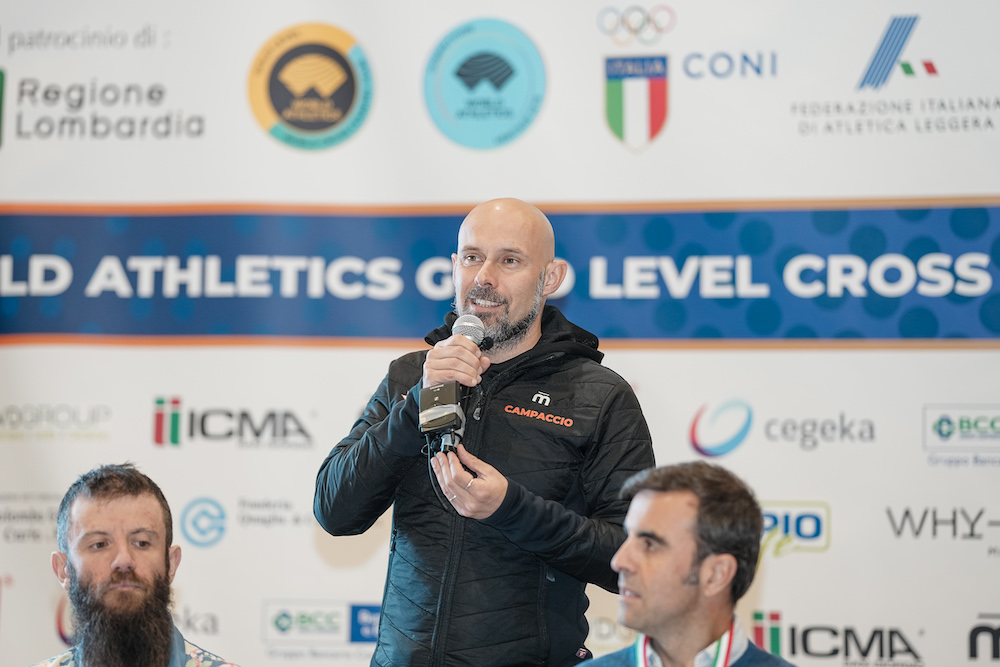
Photo by Grana/Campaccio
From the page to the track
Tiberti can trace some of his own thinking about teaching back well before he entered coaching.
At elementary school, a teacher he remembers as “Maestra Edda” showed him that knowledge alone was not enough. Expertise also required the ability to deal with people.
Later, as he developed as a coach, he worked with Professor Massimo Magnani, then Head of Performance at Italian Athletics.
While studying coaching theory, Tiberti was able to watch the same principles being applied in practice.
“I got to see how what I was reading on paper was effectively being applied in the field,” he says.
He describes himself as a product of the “Italian School of Marathon”, while his friendship with Italy’s mountain and trail running head coach Paolo Germanetto opened another part of the sport to him and eventually helped draw him towards off-road running.
Those experiences underline a distinction that sits at the centre of the Coach Networking Project.
Qualifications and formal education matter. But coaching also involves judgement, relationships, context and thousands of decisions that are difficult to reproduce in a classroom.
Mentoring can shorten the distance between knowing something in theory and understanding what it looks like with an athlete standing in front of you.
“Having a good mentor is likely the fastest way for a coach to transition from theoretical training to practical, on-the-field experience,” Tiberti says.

Photo by Gulberti/Corsainmontagna.it
Getting comfortable with not knowing
Insecurity is another barrier to learning that Tiberti thinks is common among coaches.
Asked why coaches can sometimes appear reluctant to share methods or ideas, he doesn’t think secrecy is necessarily the main problem.
“The fear of ‘not measuring up’ – that is what we must overcome,” he says.
He sees coaches worrying that they are not knowledgeable enough, not prepared enough, not strong enough as leaders or not sufficiently capable of helping others.
That can make open discussion harder.
Tiberti’s answer is not that every coach should project greater certainty – it’s almost the opposite.
“We must start from where we are to change our situation, one step at a time,” he says.
Recognising what you know, and what you do not, gives you somewhere to start. From there, experience can be added gradually.
“Brick by brick, we build our house of skills and create bridges rather than walls.”
For a project involving coaches from 22 different Member Federations, those bridges can lead in several directions.
A conversation might introduce new technical terminology, a different organisational structure or simply another way of approaching the same coaching problem.
“Variety is an asset,” Tiberti says.
In his own field of mountain and trail running, that can be particularly useful because the disciplines are relatively recent additions to the broader athletics structure and national approaches can differ significantly.
But Tiberti doesn’t believe those benefits need to stay within individual event groups.

Photo by Gulberti/Corsainmontagna.it
Mixing the disciplines
Italian Athletics has deliberately encouraged greater exchange between disciplines in recent years, to spectacular success.
Tiberti points to the approach taken under High Performance Director Professor Antonio La Torre, with coaches and athletes from different areas mixing during training camps and championships rather than staying permanently within their own groups.
“We don’t put up barriers; everyone mingles with everyone else, regardless of background or role,” he says.
Sometimes that is as simple as sharing a table at dinner.
“When lines of communication open up, mutual learning emerges spontaneously, alongside curiosity, dialogue and support.”
That thinking is reflected in the design of the Coach Networking Project.
Shot put, long jump, off-road running and junior-to-senior transition present very different technical challenges. But many coaching questions cut across all four.
How do you communicate with an athlete who is losing confidence? When should you intervene and when should you leave them alone? How do you manage workload? How do you work within a larger support team? How do you respond when results do not match expectations?
Those are not shot put or trail-running questions. They’re coaching questions.
And as support teams around elite athletes have expanded, Tiberti believes the ability to communicate has become even more important.
“The coach – a key figure and the athlete’s closest point of reference – must possess increasingly refined communication skills,” he says.
Technology has developed quickly too, but Tiberti is wary of overstating its importance.
A coach can manage without being an expert in every new technology, he argues. What they cannot manage without is the ability to identify and work with people who possess expertise they do not.
That again turns coaching development into a question of connections as much as individual knowledge.
Supporting the transition
One of the four strands within the project focuses specifically on the transition from junior to senior athletics.
It’s a period in which the demands placed on athletes can change quickly. Results can become harder to come by, competition stronger and expectations greater. The support required from coaches changes with it.
Tiberti’s view starts with the person rather than the performance.
“Nobody needs an unhappy champion,” he says.
Difficult periods are inevitable, and athletes may even reach a point where continuing in the sport no longer feels right. Tiberti believes coaches should be able to acknowledge those possibilities rather than treating every setback as something that simply has to be pushed through.
The same principle applies to the coaches themselves.
Workload, difficult athlete relationships, poor results or communication problems can all become sources of pressure.
“You can ask for help,” Tiberti says. “No one is forced to face difficulties alone.”
That help might come from another coach, a psychologist, a manager or somebody the coach trusts. The important part is recognising when support is needed.
It fits with a broader change Tiberti has observed during his career.
He believes coaching has gradually moved away from a narrower “no pain, no gain” view of performance towards the more human, longer process of helping an athlete produce consistent and mature performances without reducing their value to the result itself.
Looking back, that’s one area in which he would change his own coaching.
He would make it clearer to athletes that performance was never the sole objective, but rather one possible outcome of the work they were doing together.
“Athletes sometimes perceive, often mistakenly, that they are being judged negatively as individuals after a poor performance,” he says. “That should never be the case.”
Mentoring without making copies
For Tiberti, mentoring another coach does not mean handing over a ready-made model.
He wants developing coaches to find their own style.
That’s easier said than done. Even Tiberti admits “style” is difficult to define. But he believes coaching talent exists, and that part of a mentor’s role is recognising it and giving it room to develop.
When he does have the opportunity to mentor somebody over a longer period, he deliberately reinforces their own ideas rather than continually replacing them with his.
“It is simply a matter of recognising it and helping it to blossom,” he says.
That’s also where the longer-term nature of the Coach Networking Project becomes important.
A single seminar can introduce an idea, while an ongoing relationship gives a coach somewhere to return with questions, problems and experiences as their own work develops.
It also makes the exchange less one-directional. Lead coaches bring experience, but participating coaches bring different event knowledge, national systems and perspectives of their own.
For Tiberti, that variety is part of the value rather than something to be standardised away.
He’s less interested in creating one European model of coaching than in giving coaches better access to people who can challenge their thinking and help them refine their own approach.
That also means leaving room for mistakes.
Among the problems he sees in developing coaches are a lack of confidence, failure to appreciate the educational role of sport and, perhaps less obviously, neglecting their own development.
Coaches spend so much time focusing on athletes that their own learning can become secondary.
Tiberti argues that they need time to study, deepen their knowledge, maintain their enthusiasm and develop whatever particular strengths they bring to the role.
That makes coach development a longer process than completing a qualification or attending a course.
It’s continuing education, but also continuing exposure to people with different experiences and perspectives.

A network beyond borders
If the Coach Networking Project works as intended, Tiberti believes its value could extend beyond the immediate group of 52 coaches.
He can imagine the same approach working locally, nationally and internationally, potentially crossing not only event boundaries but sporting ones too.
“It can translate into a model successfully applicable at various scales – local, national, international and global,” he says.
He even raises the possibility of a future in which coaching expertise moves more freely between national systems.
“I cannot say whether we will ever manage to have a European network of interchangeable coaches serving different national teams at different times,” he says, “but such a scenario would not daunt me.”
That’s perhaps the bigger opportunity behind the project.
Europe already contains a huge range of coaching experience across disciplines, clubs and Member Federations. The challenge isn’t simply creating more knowledge, but making it easier for existing knowledge to travel.
Networks help with that. They give younger coaches access to experience they might otherwise struggle to find, while allowing established coaches to encounter different ways of working themselves.
The aim isn’t uniformity – it’s better access to ideas, people and support.
Tiberti’s advice to a young coach reflects much of the same thinking.
Choose carefully where you learn. Find mentors or, at the very least, colleagues who are genuinely interested in the work. Respect the athletes you coach, take responsibility and accept that mistakes will happen.
And keep investing in your own development.
“Never stop studying and investing in yourselves,” Tiberti says, “in terms of sports culture and a sustainable journey towards becoming better coaches in the future.”
For European Athletics, building stronger coaching systems is partly about formal education and technical knowledge.
But it’s also about giving coaches more opportunities to do what Tiberti was fortunate enough to do early in his own career – watch good people work, ask questions, make mistakes, talk them through and gradually work out what kind of coach they want to become.