



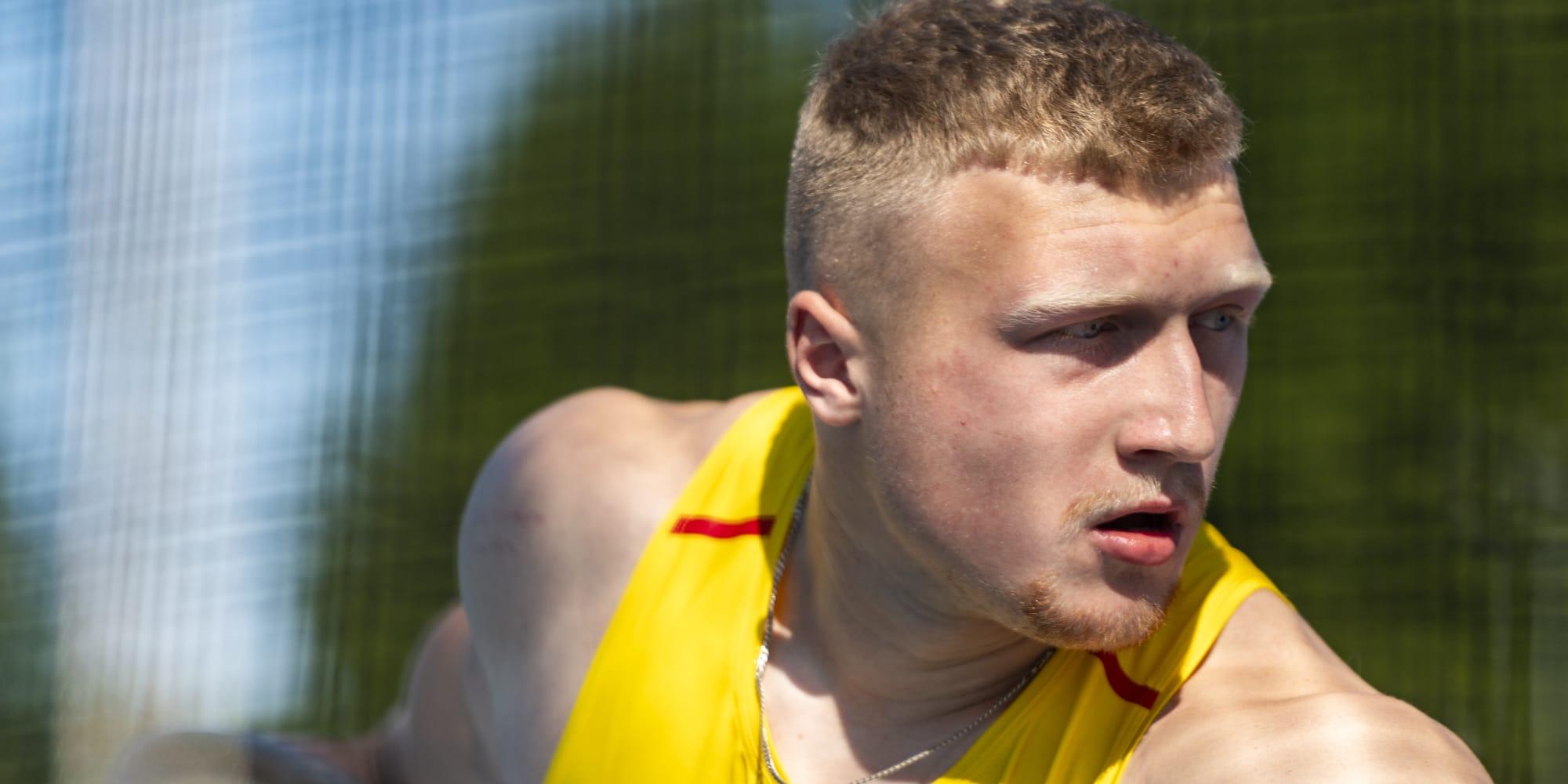


Each year many of the word’s best throwers descend on the small town of Ramona in Oklahoma dubbed 'Throw Town', where it has almost become a tradition for a discus world record to fall there.
Two years on the bounce Lithuania's Olympic and world silver medallist Mykolas Alekna has broken the men’s discus world record at the Oklahoma Throws Series, even breaking it twice in one competition last year.
In 2025 Australia’s Matthew Denny also broke the previous world record in the same competition, but he threw it after Alekna had already extended it further.
World records, area records, national records, qualifying standards - it’s the place to be for discus throwers to reach all those milestones.
Why are so many records broken?
The facility used for the competition was built specifically with the throws in mind, rather than being sat within a typical track facility.
It was built to be able to capitalise on the area's strong winds, with several throws’ circles built around the field so each one can be used for optimal conditions.
The wind is particularly useful for discus throwers as a head wind, if used correctly, can help carry the discus even further – leading to records being broken.
This means that many of the worlds top discus throwers make the journey to Ramona to chase PB’s, records and qualifying standards in the very early stages of the season.
Aren’t strong winds illegal?
In sprints and horizontal jumps events a tailwind wind of more than +2.0m/s means that any records or PB’s are not valid due to being wind assisted, however this is not the case in the throws events.
This is because the wind can influence the implement in multiple ways and the result is still highly dependent on the athlete’s technique, especially discus. It is not as simple as more wind means a further throw.
A tailwind in discus could push the implement down therefore shorten it’s flight path, while a headwind can keep it up and make the throw further due to the angle of the implement.
However, crucially the athlete must know how to use the wind to their advantage.
The wind has less of an impact on the heavy throws, hammer and shot, due to the weight of the implements but it can still influence the distance of a throw.
Do qualifying standards stand?

With the Birmingham 2026 European Athletics Championships looming this summer, athletes will be looking to secure qualifying standards as soon as possible, and Ramona could be the perfect place.
Any distances thrown beyond the qualifying standards will stand as there is no wind limit for the throws.
Birmingham 2026 qualifying standards:
Discus: women – 61.00m, men – 65.50m
Shot put: women – 18.20m, men – 20.80m
Javelin: women – 60.80m, men – 83.00m
Hammer: women – 71.50m, men – 77.00m
Who is competing this year?

So far Slovenia's former world champion Kristjan Ceh is the only athlete to have explicitly stated he will be competing this year, where he’ll be making his debut in Ramona.
The defending world record holder, Alekna, won’t be competing this year due to tearing his pec in March and requiring surgery.
Other athletes that have competed in Ramona in previous years that could return include Germany’s Clemens Prufer and Henrik Janssen, Great Britain’s Lawrence Okoye, and France's Melina Robert-Michon.
When is the competition in 2026?
The annual Oklahoma Throws Series competition returns to ‘Throw Town’ Ramona, America, from 10-13 April for the World Athletics Continental Tour Bronze event.
Category F competitions are listed for 28 and 29 March, in addition to 4, 6, 9, 18, 19, 25 April, and 23, 24, 30 May.