


Major championships are traditionally measured by fractions of a second, medal counts and the roar of the stadium crowd. Yet the true integrity of an event is decided just as emphatically away from the cameras.
Through its Race for Respect initiative, European Athletics placed human rights, safeguarding and individual well-being at the core of Birmingham 2026, moving beyond high-level governance declarations to examine how these values actually function on the ground.
From ethical supply chains and technical officiating to athlete empowerment and the volunteer workforce, this four-part series explores how the fundamental principles of dignity, fair play and mutual respect were lived across Alexander Stadium.
Respect where it matters
For the thousands of people involved in delivering a major athletics championship, human rights are rarely expressed through policies or declarations during the working day.
They are found in the decisions people make and the way they treat one another.
They can mean an official making sure an inexperienced athlete gets the same opportunity to warm up as an established champion. They can mean checking that a colleague working for hours in the heat has enough water and time in the shade.
For a volunteer, they can mean having a role adapted because standing for long periods is difficult, knowing exactly where to report a safeguarding concern or being trusted with responsibility regardless of age.
At Birmingham 2026, those everyday interactions provided some of the clearest examples of Race for Respect in practice.
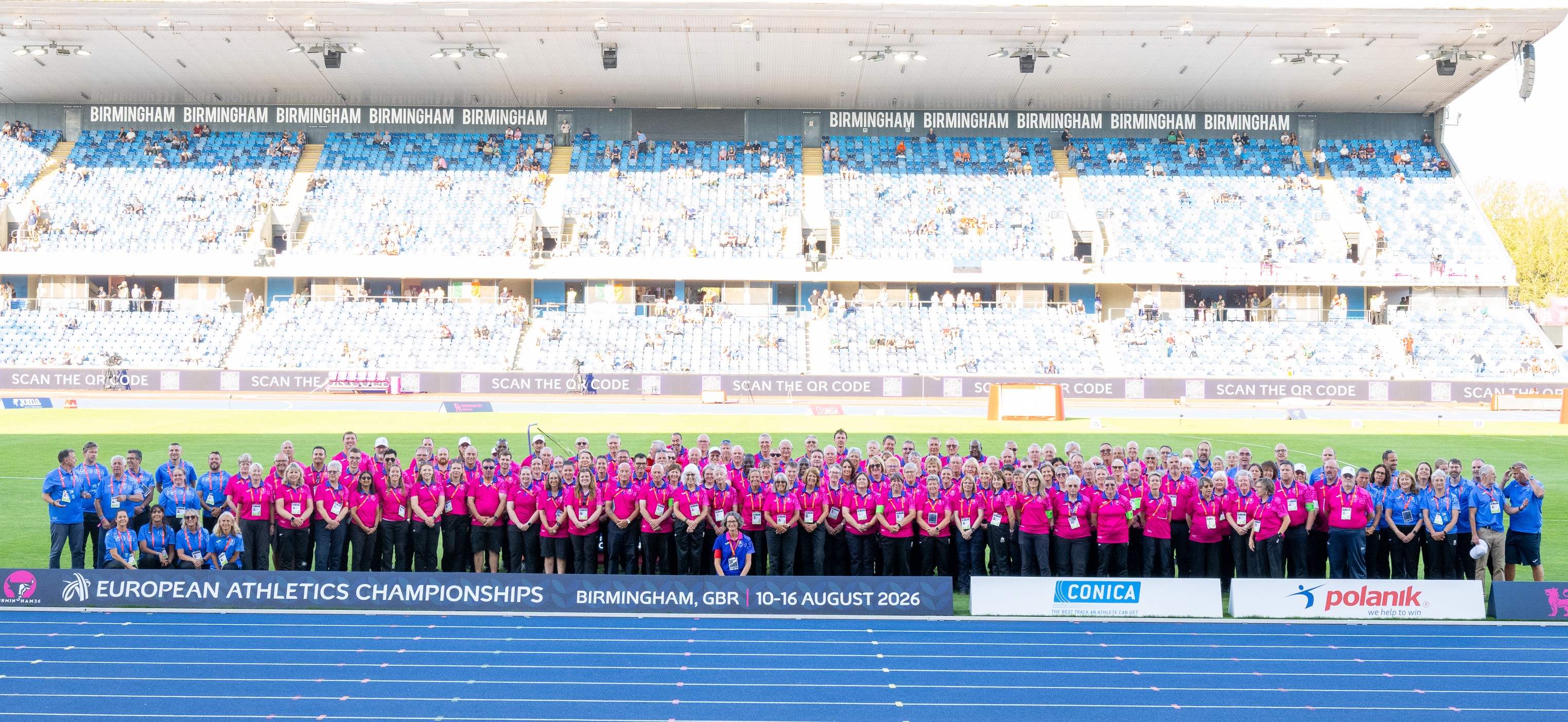
From authority to partnership
Few people have witnessed the evolution of athletics officiating as closely as respected British technical official Chris Cohen CBE.
For Cohen, one of the most significant changes has been in the relationship between officials and athletes.
“The situation has changed over the years, from officials regarding themselves as ‘masters of the universe’ where everybody had to do exactly what they were told,” he said.
“There is much more understanding now amongst officials that they are part of a team, and the athletes are part of that same team. They need to work together to produce good performances and allow athletes to be at the centre of what is going on, rather than the officials.”
That shift has practical implications.
An athlete arriving at a major championship may be an experienced international competitor accustomed to performing in front of thousands of spectators. Another may be experiencing the environment for the first time.
Both have the same right to be treated fairly and with dignity.
“Officials understand the athletes’ situation far better today,” Cohen said. “It is about allowing them to express themselves in the best way they can, but also ensuring that the athlete who is nervous or feeling overwhelmed still has that platform to do their best, even if they are going to finish last.
“It doesn't matter as far as the official is concerned, it is about giving them the opportunity to perform without being overwhelmed by their fears.”
Fair play for every athlete
Equal treatment does not necessarily mean standing back and allowing events to take their course.
Sometimes officials have to intervene to ensure every athlete receives a fair opportunity.
That can be particularly important during warm-ups, when experienced or more assertive competitors may naturally command space and attention.
“You can tell fairly soon which athletes are the stars, but our job is ensuring they all have that opportunity to perform at their best within the rules and protecting each group from one another,” Cohen explained.
“In warm-ups, you might get athletes who are quite assertive and try to take as many attempts as possible to the detriment of others.
“High-standard officiating ensures the shy or inexperienced athlete gets their fair share of time on the long jump runway or the circle, ensuring everyone gets what they need without disadvantaging anybody else.”
It is a small example, but an important one: fairness at a championship is not simply contained within a rulebook. It depends on people recognising where an imbalance might occur and ensuring that everybody receives an equitable opportunity to compete.

Caring for those who deliver the championships
The same duty of care extends beyond athletes.
Officials and volunteers can spend long hours working in demanding conditions, making their own welfare an important part of responsible event delivery.
At Birmingham 2026, Cohen saw that responsibility reflected in practical measures during lengthy sessions in the heat. Meeting managers were tasked with looking after officials’ welfare, while access to shade, ice and water and support from medical staff helped protect the workforce.
“On a brutally hot day, that means making sure officials take time out, rotate into the shade and have ice and water out on the field alongside the athletes,” Cohen said.
“We have dedicated medical staff who aren't just looking after the competitors, but actively checking on the officials and staff.
“Throughout the day, part of my role is just wandering around, tapping people on the shoulder, asking: ‘Are you okay? Do you need water? Do you need support?’
“It comes down to having the right people with the right attitude looking after their colleagues.”
A championship open to everyone
Among the volunteer workforce, that same principle of dignity begins with who gets the opportunity to participate.
Birmingham local Julia Bellingham began volunteering at major events during the 2022 Commonwealth Games. At Birmingham 2026, she found a workforce encompassing different ages, backgrounds, heritages and physical abilities.
“If you sit in that room and look at the representation of volunteers, we are from all walks of life, all age groups, all heritages and a full range of abilities,” she said.
“The range of roles ensures accessibility for all, which is not always true in society or standard work environments.”
For Bellingham, accessibility is also personal. Because a medical condition means she cannot stand for long periods, adjustments and regular check-ins allow her to contribute without compromising her well-being.
“If people are excluded from opportunities, that is just not right,” she said. “Here, if you have mobility issues, roles are adapted. I can't stand for long periods due to a medical condition, and the team proactively checks in: ‘Is half an hour too much? Is it time for a rotation?’
“That front-line duty of care is exactly what you look for.”
Volunteer Manager Hannah Hogben saw another barrier during recruitment: people ruling themselves out before they had even been given an opportunity.
“It broke my heart during recruitment when so many people came in saying, ‘You probably won’t want me because I’m too old, too young, or don't have experience,’” she said.
“We put them right immediately. We work across all areas to ensure volunteers feel safe, supported and never judged, giving them the space to step outside their comfort zone with the backing they need.”
### Safeguarding that people can see and use
Creating an inclusive environment also means ensuring people know what to do when something goes wrong.
For Bellingham, who has experience working with children’s charities, one of the most important features of Birmingham 2026 was the visibility of safeguarding within volunteer training and championship operations.
“From pre-event training, there are clear guidelines on security and safeguarding,” she said. “It is brilliant to see safeguarding being treated as a non-negotiable part of training outside institutional care environments.
“Everyone understands what to do, what to look for, and who to go to if an issue arises.”
Just as importantly, she said, reporting needs to lead to a response.
“In practical terms, the reporting channels are clear, and I have always felt completely supported by the management team. When concerns are raised, they are dealt with properly, and you get direct feedback so you know action was taken.”
Respect across generations
Inclusion can also challenge assumptions about who should lead.
Bellingham highlighted young volunteer team leaders in their early twenties being trusted to manage colleagues considerably older than themselves.
“Seeing 20 or 21-year-olds given the opportunity to develop leadership skills and manage people twice their age is a fantastic perspective on equity,” she said.
“Our young team leader stepped up brilliantly, and it’s a two-way street. I’ve learned things from them that changed my own approach, while older volunteers can help connect young people interested in event management with valuable career contacts.”
For some volunteers, the impact can extend well beyond the final event of the championships.
“We’ve had women over 50 deliberately pushing themselves into new roles to prove to themselves what they can still do after battling confidence or anxiety,” Bellingham added.
“We are here to deliver a phenomenal championship, but making a tangible, positive difference in a volunteer’s personal life behind the scenes is the real, hidden triumph of this event.”
Turning principles into practice
The experiences of officials and volunteers at Alexander Stadium illustrate a common theme.
Human rights at a major sporting event are not delivered by a single policy, training session or campaign message. They depend on hundreds of everyday decisions: giving an athlete space to prepare, making an adjustment for a volunteer, checking on a colleague in the heat, trusting a young person to lead or ensuring somebody who raises a concern knows they will be heard.
For Race for Respect, that is where broad commitments to dignity, equality and well-being become tangible.
The medals and performances will remain the most visible legacy of Birmingham 2026. But behind them is another measure of a successful championship: whether the people who competed, officiated and volunteered were given the opportunity to participate fairly, safely and with respect.
I’ve kept the voices and examples closely grounded in the supplied case studies, including Cohen’s account of the changing official-athlete relationship and welfare arrangements , and Bellingham and Hogben’s experiences of accessibility, safeguarding and intergenerational empowerment.